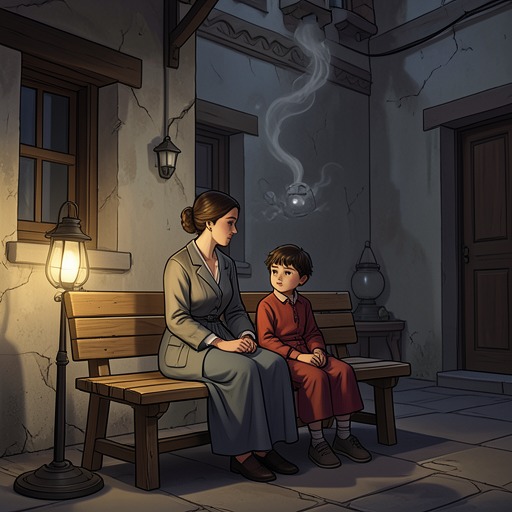
L’oubli dans lequel il nous a laissés, fais-le-lui payer cher, mon enfant.
Pedro PáramoThe expression L’oubli dans lequel il nous a laissés, fais-le-lui payer cher, mon enfant. gives Dolores Preciado’s abandonment the force of a final instruction to her son, Juan Preciado. Its decisive tension lies between restraint and retaliation: she forbids him to demand more than what is owed, while insisting that Pedro Páramo must answer for having left them in oblivion.
A deathbed instruction
Dolores speaks as she is dying, with Juan holding her hands and promising to visit the father he has never known. She tells him not to ask Pedro for anything, but to claim only their due: what Pedro owed her and never gave. The appeal to make him pay is thus framed not as a claim to new benefits but as the collection of an old, unpaid debt. Her instruction binds the absent father’s neglect to the son’s promised journey to Comala.
Juan’s immediate reply is an assent, but the promise does not begin as a settled intention. He admits that he did not expect to keep it, at least until dreams and illusions began to grow in him. He then built a world around the hope represented by Pedro, his mother’s husband, and came to Comala. The expression therefore precedes the journey as a maternal demand, while Juan’s eventual decision is shaped by a hope that is not identical to her demand for repayment.
The phrase returns with Dolores’s history
The wording recurs when Eduviges Dyada explains Dolores’s departure from Media Luna. After Dolores had left for good, Eduviges went to ask Pedro about her months later. Pedro dismissed the question: he said Dolores had loved her sister more than him, supposed she must be content where she was, and admitted that she had begun to irritate him. Asked how Dolores and her family would live, he left their welfare to God. Eduviges’s account gives the expression’s accusation a concrete context: Pedro knows Dolores is gone and chooses not to concern himself with what follows.
The account also recalls the circumstances of Dolores’s life after leaving. In Colima, she and Juan depended on her aunt, who told them to their faces that they were a burden. The aunt asked why Dolores did not return to her husband. Dolores answered that he had sent no one to fetch her and that she would not go back unless he called for her; she had come to see her sister because she loved her. Even when her aunt eventually said it was time for her to leave, Dolores’s explanation made the separation a matter of both affection and refusal: she would not restore the marriage on her own while Pedro made no move toward her.
Reproach, debt, and the failed summons
When Eduviges repeats Dolores’s appeal to make Pedro pay, the words connect the mother’s private parting instruction with the account Juan receives of her past. Their recurrence makes the grievance more than a single deathbed utterance: the son hears the same charge again while learning that Dolores left Media Luna, that Pedro showed little concern for her fate, and that she waited for him to summon her rather than return uninvited.
The expression holds together two claims that do not quite coincide. Dolores limits what Juan may ask for, insisting on what is already owed, but the demand that Pedro pay makes neglect sound like an injury with consequences. Juan, meanwhile, arrives not simply to enforce that debt but after imagining a hopeful world around his father. The phrase marks the burden his mother hands on; the story of her departure reveals the history that gives the burden its weight.